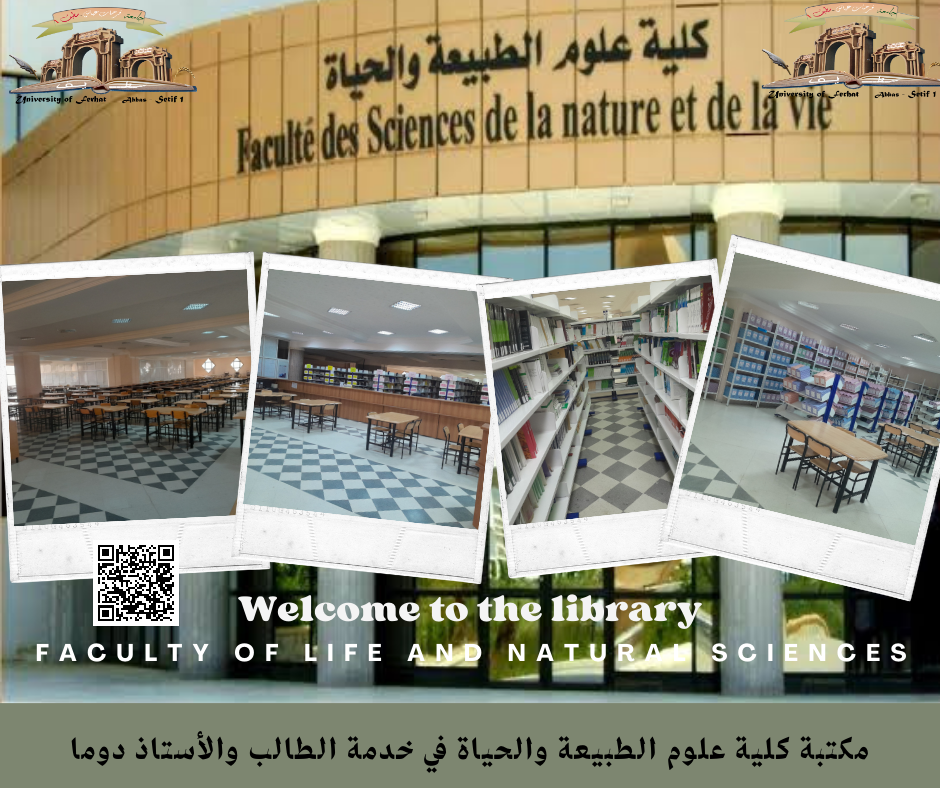
Catalogue de la bibliothèque de SNV
A partir de cette page vous pouvez :
| Retourner au premier écran avec les catégories... | Votre compte | Aide |
Détail de l'auteur
Auteur Sabira Sellami |
Documents disponibles écrits par cet auteur


 Affiner la recherche
Ethnopharmacological study and evaluation of in vitro antioxidant and anti-inflammatory activities of Chenopodium quinoa Wild. / Sabira Sellami / Faculté des sciences de la nature et de la vie (2025)
Titre : Ethnopharmacological study and evaluation of in vitro antioxidant and anti-inflammatory activities of Chenopodium quinoa Wild. Type de document : document électronique Auteurs : Sabira Sellami, Auteur ; Assia Zitouni, Auteur ; Noureddine Charef, Directeur de thèse Editeur : Faculté des sciences de la nature et de la vie Année de publication : 2025 Importance : 37 Feuilles ISBN/ISSN/EAN : MS/2209 Langues : Français Catégories : Thèse et mémoire:Master:Biochimie appliquée Mots-clés : Chenopodium quinoa Wild Phytochemicals Ethnopharmacological Antioxidant activity Anti-inflammatory activity Toxicity. Résumé :
Chenopodium quinoa Wild is an ancient food crop belongs to the Amaranthaceae family. It is gluten-free this makes it a healthy, especially individuals with gluten sensitivity. This study sought to perform an ethnopharmacological survey, acute toxicity, in vitro anti-inflammatory and antioxidant properties of C. quinoa Wild. Results from an ethnopharmacological questionnaire indicate that 5.4% of people are prominently used as a primary dietary component, especially for celiac patients. The quantitative phytochemical analysis revealed that the overall polyphenol, flavonoids and tannins contents present a values of 95.3 ± 2.42 μg gallic acid equivalent; 6.22 ± 0.18 μg quercitine equivalent and 21.93 ± 5.89 μg catechin equivalent/mg dried extracts, respectively. The in vivo toxicity test indicated that the ethanolic extract (EthE) from C. quinoa Wild seeds exhibited no adverse effects or fatalities in mice, the median lethal dose (LD50) when administered orally exceeded 2 g/kg (body weight). In vitro antioxidant activity showed a scavenging activity. The ethanolic extract (EthE) of the seeds also displayed in vitro anti-inflammatory potency and dose dependent. Through ethnomedicinal study, our findings prove the medicinal use of Chenopodium quinoa Wild in traditional medicine and as an additional source for natural anti-inflammatory and antioxidant agents.Ethnopharmacological study and evaluation of in vitro antioxidant and anti-inflammatory activities of Chenopodium quinoa Wild. [document électronique] / Sabira Sellami, Auteur ; Assia Zitouni, Auteur ; Noureddine Charef, Directeur de thèse . - Setif, Algerie : Faculté des sciences de la nature et de la vie, 2025 . - 37 Feuilles.
ISSN : MS/2209
Langues : Français
Catégories : Thèse et mémoire:Master:Biochimie appliquée Mots-clés : Chenopodium quinoa Wild Phytochemicals Ethnopharmacological Antioxidant activity Anti-inflammatory activity Toxicity. Résumé :
Chenopodium quinoa Wild is an ancient food crop belongs to the Amaranthaceae family. It is gluten-free this makes it a healthy, especially individuals with gluten sensitivity. This study sought to perform an ethnopharmacological survey, acute toxicity, in vitro anti-inflammatory and antioxidant properties of C. quinoa Wild. Results from an ethnopharmacological questionnaire indicate that 5.4% of people are prominently used as a primary dietary component, especially for celiac patients. The quantitative phytochemical analysis revealed that the overall polyphenol, flavonoids and tannins contents present a values of 95.3 ± 2.42 μg gallic acid equivalent; 6.22 ± 0.18 μg quercitine equivalent and 21.93 ± 5.89 μg catechin equivalent/mg dried extracts, respectively. The in vivo toxicity test indicated that the ethanolic extract (EthE) from C. quinoa Wild seeds exhibited no adverse effects or fatalities in mice, the median lethal dose (LD50) when administered orally exceeded 2 g/kg (body weight). In vitro antioxidant activity showed a scavenging activity. The ethanolic extract (EthE) of the seeds also displayed in vitro anti-inflammatory potency and dose dependent. Through ethnomedicinal study, our findings prove the medicinal use of Chenopodium quinoa Wild in traditional medicine and as an additional source for natural anti-inflammatory and antioxidant agents.Exemplaires
Code-barres Cote Support Localisation Section Disponibilité MS/2209 BAPP/CD250 DVD et CD Bibliothèque SNV Englais Disponible